
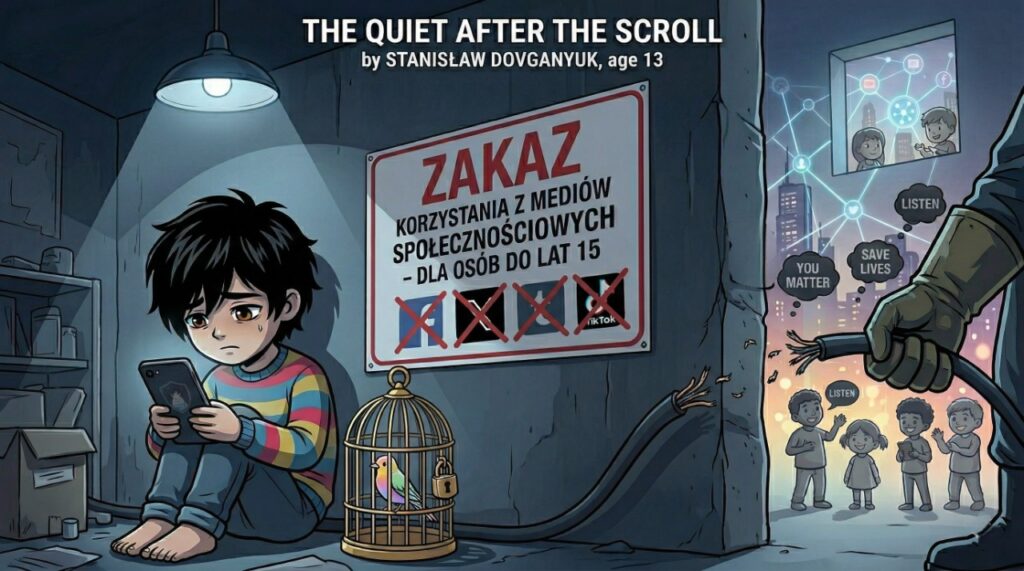
Foreword / Introduction
Poland is planning to ban anyone under 15 from using social media. That includes me, and I’m not someone who’s just going to sit quietly while that happens. Too many children’s rights and disability rights groups have already shown that the harms of social media bans far outweigh any supposed benefits—if there even are any real benefits to begin with.
One of the worst parts is how weak the reasoning behind these bans actually is. Many of the problems they point to began when adults started pushing mature content away from age-appropriate spaces. If that content simply went back to proper adult platforms, most of their arguments would fall apart overnight. The same goes for things like addiction. That’s not an age issue—it affects adults as much as young people. If they really believe social media should be banned because of addiction, then by their logic it should be banned for everyone. Maybe it’s time they looked in the mirror and faced that truth.
For those of us who struggle to communicate outside the internet, these bans would trap us behind walls. The consequences could be far worse than anyone realises. Imagine being me at five years old, when I was being abused and had no one to help me. That’s the kind of situation these bans could create—the lifelines children use to reach out would be cut off, leaving them more isolated and unsafe than ever before.
Poem: The Quiet After the Scroll
There’s talk that the screens will go dark soon,
that our worlds will shrink back into corners again.
Adults say we’ll be safer that way,
like silence ever saved anyone.
They never see what happens behind closed eyes,
how we build whole selves from comments and whispers,
how we learn the word alive
from someone else typing, you matter.
Now, it’s the end of that light between us,
the end of the tiny thread holding the scared ones together.
They call it protection, I call it forgetting.
They forget what it’s like to choke on loneliness,
what it’s like when laughter hides bruises.
They craft new laws like bandages too tight,
pressing down until even breath becomes disobedience.
We’ll learn to hide, not heal.
We’ll turn off honesty, switch on masks.
They will celebrate peace and never hear
the quiet cracking underneath.
Once, strangers found each other through noise.
A boy made a drawing, someone said same.
A girl wrote a poem, a thousand hearts flickered.
Now all of that becomes evidence.
Every post a risk, every thought a rule broken.
Funny, isn’t it, how they wanted less harm
and built taller walls instead.
I wonder if walls can blush
when they realise they’ve silenced what they swore to save.
Adults forget—bullies don’t need Wi-Fi.
They know how to find us offline too.
The difference was that before,
there were people who saw, who cared,
who whispered don’t give up, from three countries away.
Without that, pain becomes local again,
and whispers never cross oceans anymore.
It’s strange how loneliness travels faster
when the internet stops moving.
They think they’re cutting poison out of our veins,
but the blade is too blunt and the hand is too clean.
They don’t see what they’re scraping away—
all the small, soft things that made us hold on.
I remember nights where words saved lives
in chat boxes no adult cared to enter.
That was the kind of miracle we built
from pixels, noise, and trust.
Now they’re banning miracles too.
The headlines glow with promises:
Safer Children! Healthier Minds!
But no one asked why their cure sounds like silence.
No one asked what happens
to voices that never learned to shout.
When the feed dies, confession dies with it.
When the likes fade, so does proof
that someone somewhere was listening.
And I’ve learned that being unseen
hurts more than any comment ever did.
They think this is peace—
quiet, polished, unbothered peace.
But peace without truth is just a prettier prison.
And we’re growing up inside it,
learning to mimic smiles, learning to nod.
Soon enough, we’ll inherit their world,
and they’ll ask why it feels so empty.
Maybe then they’ll understand
what happens when you outlaw connection.
I can already see the cracks ahead:
divides too wide for mendable words,
adults trying to teach kindness
in a language none of us use anymore.
They broke the bridge and blamed the river.
They called our screams distraction,
our openness addiction.
Now the echo starts fading,
and no one notices the silence is screaming back.
We are not the threat.
We are the message they refused to read.
Every law they pass is a stone
skipping across a lake once full of voices.
Soon only echoes will circle back,
asking who we might have been
if they’d just let us talk.
So when they unplug the world,
remember who gets left in the dark first.
Not the ones writing the rules—
the ones still learning how to speak at all.
And when no one replies anymore,
that’s not safety. That’s forgetting.
